
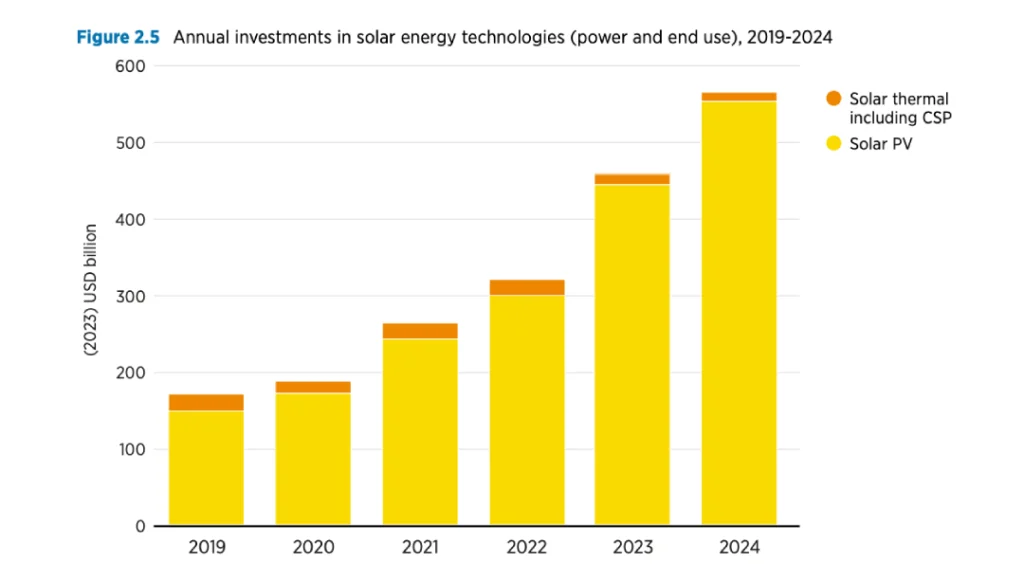
Global investment in solar technologies is set to hit a new all-time high of $554 billion in 2024, according to a new report from the International Renewable Energy Agency (IRENA). This investment is just one part of the accelerating global clean energy development, but solar is now the only renewable technology with investment levels approaching the annual average needed to achieve a 1.5°C scenario by 2030.
Solar accounts for 69% of total renewable energy investment
A total of $807 billion in investment was allocated to renewable energy technologies in 2024, with solar accounting for 69% of this figure. According to the IRENA report, this impressive growth was largely driven by supportive policies, the development of large-scale power plants, and the reduction in the cost of solar equipment on both a small and large scale.
A 49% increase over the average of previous years has solidified solar’s position as the main driver of the energy transition in 2024.
China, Europe, and the U.S. Lead Solar Investments
According to the report, China, Europe, and the United States accounted for nearly 70% of global investment in solar technologies in 2024. Additionally, countries such as Brazil, India, Pakistan, and South Africa have seen significant growth in solar investments, and their share is expected to rise in the coming years.
Global Challenges to Solar Development
While IRENA views the growth in investment positively, it also highlights several key challenges that could slow progress, including:
-
Changes in the global supply chain
-
Trade and tariff uncertainties
-
Macroeconomic conditions and market fluctuations
-
Geopolitical developments
The report emphasizes that sustaining this growth will require new business models, increased energy storage capacity, and supportive policy frameworks.
Decline in Supply Chain and Solar Factory Investments
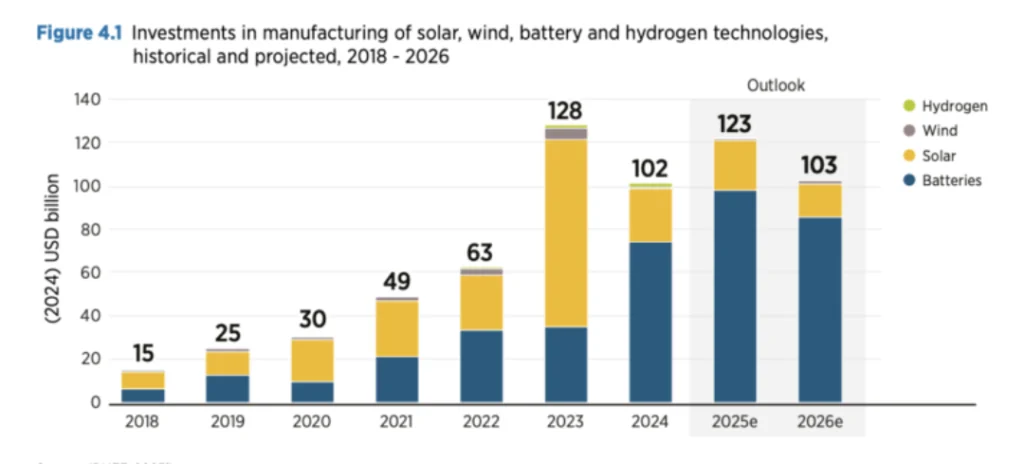
Investment in renewable energy supply chains fell by 21% to $102 billion last year. A major portion of this decline was due to a 72% drop in investments in solar equipment manufacturing, as the global market faces excess production capacity and new trade barriers in several countries.
Conversely, investments in battery manufacturing plants grew significantly, reaching $74.5 billion, with China alone accounting for 84% of these investments in 2023 and 2024.
Investment Trends for the Coming Years
IRENA forecasts that total investments in solar, wind, battery, and hydrogen technologies will reach $123 billion in 2025, although another decline is possible in 2026.
The report also states that global investment in energy transition technologies in 2024 reached $2.4 trillion, marking a 9% increase from the previous year. After renewable energy, the largest investment segments include:
-
Electric vehicles: $763 billion
-
Power grids: $359 billion
-
Green hydrogen: $346 billion
-
Battery storage: $54 billion
-
EV charging infrastructure: $39 billion
Total investment in renewables, grids, and storage reached $1.19 trillion, surpassing the $1.13 trillion invested in fossil fuels.
Need for Low-Cost and Developmental Financing
A key point in the report is the financing structure of renewable projects. Statistics show that 48.4% of total investments were market-rate loans, while roughly half were financed through equity. Only 1.6% of investments consisted of low-interest loans or grants.
IRENA emphasizes that to maintain the pace of the energy transition, developmental finance, low-cost loans, and risk mitigation tools must be expanded to ensure that developing countries are not left behind.